


The Fifth Wall: Why Designing the Ceiling Elevates the Entire Interior

In luxury interior design, the difference between a beautiful room and a memorable one often lies in what most people ignore: the ceiling.
At DAM Interior Design, we approach every project holistically, walls, millwork, flooring, plumbing, lighting, furnishings, and yes, the ceiling. Often referred to as the “fifth wall,” the ceiling is one of the most powerful tools for creating architectural depth, enhancing lighting, and elevating the overall experience of a space.
If you're designing or renovating a home in South Florida, especially in areas like Boca Raton, Miami, or Palm Beach, overlooking the ceiling is a missed opportunity.
What ever your design style is, there's a ceiling design to make it that much special.

Why the Ceiling Matters in Interior Design?
It Defines Volume & Proportion
In homes with 10–20 foot ceilings, common in luxury residences, Florida, or Houston residences, or where ever you may be, the vertical plane plays a critical role in visual balance. A blank ceiling in a double-height living room can feel cold or unfinished.
Strategic ceiling treatments:
Add architectural detail
Visually lower or lift perceived height
Create intimacy in expansive rooms
Improve acoustic quality
A properly designed ceiling ensures the room feels intentional rather than cavernous.
Coffered ceilings can be a traditionally classic approach, but when executed with clean lines and concealed lighting, coffered ceilings add rhythm and architectural depth without overwhelming the room.
It Enhances Lighting Design
Lighting is not just decorative, it’s architectural.
When we design ceilings at DAM Interior Design, we coordinate lighting layouts early in the construction documents phase to ensure electrical, HVAC, and millwork align seamlessly.
This is where true design-build integration makes the difference, and as I repeat over and over again, the architectural team and the design team have to work hand in hand to make this happen. if not there is a gap of misinformation about the intent for the space and can be costly and lengthy to re draw and modify all specialties on Permit plans.
When designing ceilings we incorporate Recessed cove lighting, or Integrated LED strip details as well as layered lighting plans (ambient, task, accent) to generate different moods and define spaces with just lighting.

Wood Panel, Slatted Ceilings ir Exposed Beams
Perfect for creating warmth in high-ceiling spaces. In tropical modern homes, wood ceilings add texture and organic richness while softening expansive white interiors.
In South Florida residences, we often integrate walnut or white oak tones, seamless linear diffusers, and concealed LED strip lighting for a clean, contemporary finish.
In markets like Houston or countryside estates, the approach evolves to reflect the regional architecture and lifestyle. We may incorporate wider plank ceilings, reclaimed or wire-brushed oak, cedar, or even whitewashed pine to complement transitional, ranch, or modern farmhouse aesthetics. Exposed beams, tongue-and-groove detailing, and subtly integrated mechanical systems maintain functionality while preserving character. The result is a ceiling treatment that feels grounded, warm, and architecturally authentic to its environment, while still delivering a refined, high-end outcome.
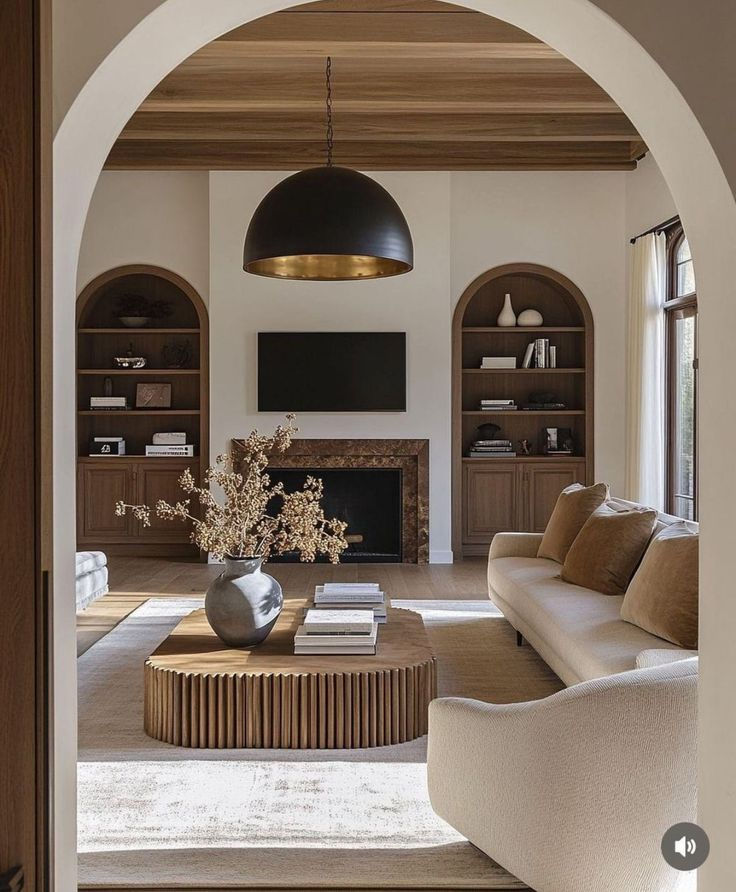
In many renovations, ceilings are left to contractors without clear design direction or a coordinated reflected ceiling plan. The result is often a space that feels incomplete, even if the finishes are beautiful. Lighting ends up placed for convenience rather than composition, with recessed cans scattered symmetrically to the room dimensions instead of aligned with furniture layouts, millwork, or architectural focal points. Air vents and return grilles interrupt carefully planned sightlines. Access panels appear as afterthoughts. What could have been a refined architectural plane becomes a flat surface punctured by mechanical necessities.
Without intentional planning, ceiling heights are also missed opportunities. Transitions between rooms feel abrupt instead of fluid. Large spaces lack proportion and intimacy. Double-height areas can feel cavernous rather than dramatic. Even subtle elements, like the alignment between a chandelier and a dining table or the spacing of linear lighting within a hallway, lose impact when the ceiling is not designed holistically.
From a construction standpoint, the absence of early ceiling coordination often leads to costly revisions. Electrical, HVAC, and framing decisions get made independently, forcing compromises later. A soffit may be added to conceal ductwork that could have been integrated elegantly from the start. Lighting layouts may shift after drywall is installed, increasing labor costs and reducing precision.
Ultimately, when the ceiling is treated as an afterthought rather than an architectural asset, the overall project loses cohesion. Luxury is defined by alignment—proportion, symmetry, integration, and intentionality. The ceiling is not just a structural necessity; it is a critical design surface that frames the entire spatial experience.
Luxury design requires foresight. Ceiling plans should be developed alongside:
Lighting design
Electrical layout
Millwork elevations
Furniture planning
This is why design-build coordination is critical to achieving flawless execution.
If you're investing in a high-end renovation or building a custom home in Boca Raton or anywhere in South Florida, make sure to ask your designer to integrate the ceiling features to their design and create RCP's to ensure that the spaces furniture and layout is backed up by its lighting plan.
At DAM Interior Design, we believe flawless design considers every surface—because luxury is in the details.
If you’re planning a renovation or new build and want a fully integrated approach, from flooring to ceiling, let’s design it properly the first time.
Flawless design. DAM good results.
Truly Yours,
Daniella Acuna M.


Comments